
🌡️ India’s Heat Problem Is Getting Worse—But AC Isn’t the Only Solution
Every summer feels hotter than the last. Electricity bills spike, ACs run non-stop, and still, many homes struggle to stay cool.
But what if your home could stay naturally cool—even in peak heat—using the temperature beneath your feet?
That’s exactly what geothermal cooling does.
Globally, this technology is already used in countries like the US, Germany, and parts of the Middle East. Yet in India, it’s still largely unexplored—especially for residential use.
This guide breaks it down in a simple way:
👉 What geothermal cooling is
👉 How it works
👉 And how you can build a basic system in India
🌍 What Is Geothermal Cooling?
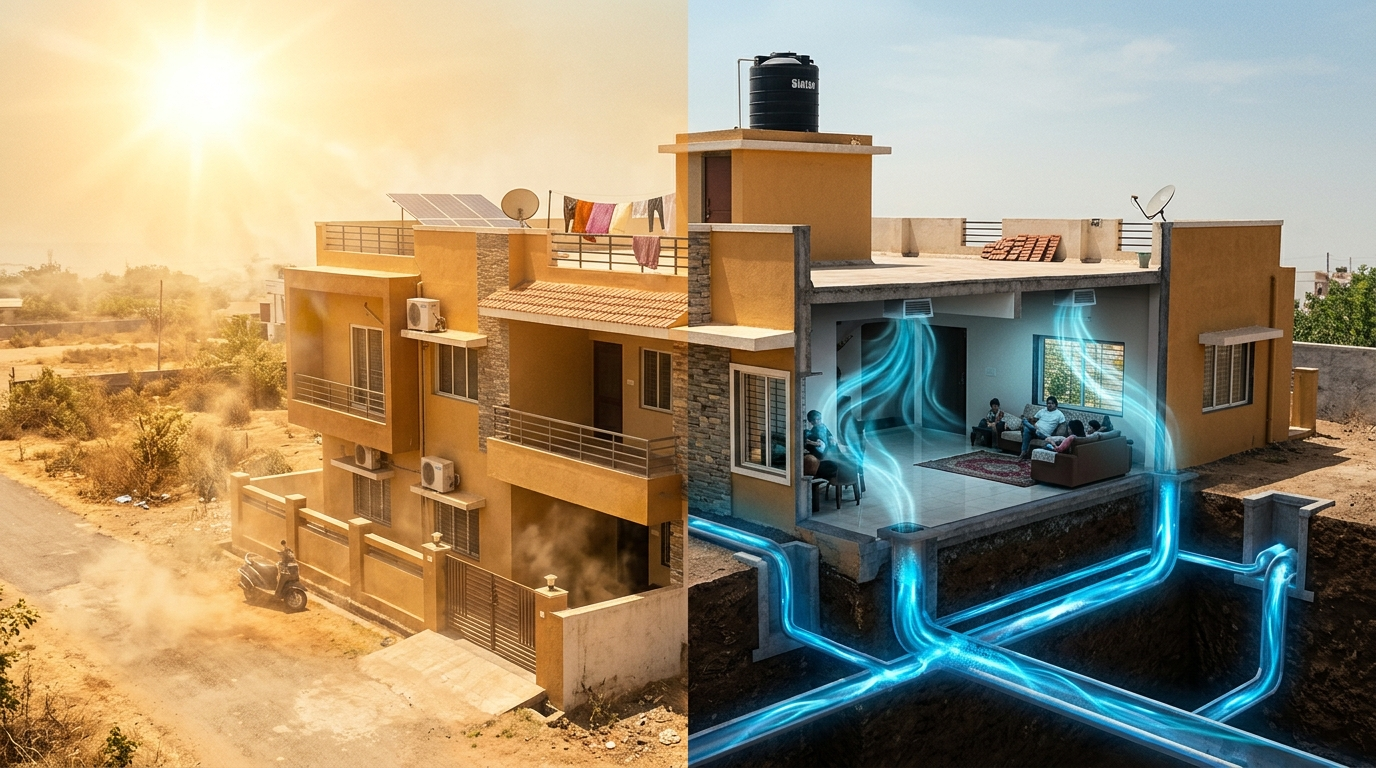
Geothermal cooling uses the stable underground temperature to regulate indoor temperatures.
At around 2–3 meters below ground, the soil temperature remains relatively constant throughout the year (typically 24–28°C in most parts of India).
Instead of fighting heat with energy-hungry ACs, geothermal systems:
- Transfer heat from your home into the ground
- Use natural cooling instead of heavy electricity
👉 Think of it as using Earth itself as a heat sink.
⚙️ How It Works (Simple Explanation)
A basic geothermal cooling system has 3 components:
- Pipes (Underground Loop)
- Fluid (usually water)
- Air circulation system (fan or duct)
Process:
- Hot air from your home passes through pipes buried underground
- The ground absorbs heat
- Cooler air returns back into your home
👉 Result: Lower indoor temperature with minimal electricity use
🔁 Two Types of Systems You Can Build in India
🟢 1. Closed Loop System (Best for Homes)
This is the most practical option for Indian households.
How it works:
- Pipes are buried underground (horizontal or vertical)
- Water circulates inside a closed loop
- Heat is exchanged with soil
Advantages:
- No water loss
- Low maintenance
- Long life
Ideal for:
- Villas
- Farmhouses
- New constructions
🔵 2. Open Loop System (More Efficient, But Limited)
How it works:
- Uses groundwater directly
- Water is pumped, circulated, then discharged
Advantages:
- Higher efficiency
Challenges in India:
- Requires water availability
- Legal restrictions in some areas
- More maintenance
👉 Best suited for:
- Rural areas
- Industrial setups
🏗️ Can You Actually Build This in India?
Yes—but with realistic expectations.
Geothermal cooling is not yet a plug-and-play product in India.
You need a custom setup, often built using basic materials.
🔧 Basic DIY Setup Concept
For a small-scale system:
- Dig trenches (3–6 feet deep)
- Lay PVC/HDPE pipes
- Circulate air or water through pipes
- Use a blower/fan to push air
👉 Even a simple system can reduce temperature by 3–6°C
💡 Where Geothermal Works Best in India
Not every house is ideal.
Works well in:
- Independent homes
- Farmhouses
- Open land areas
Less effective in:
- Apartments
- High-rise buildings
💰 Cost vs Benefit
Let’s be honest:
Geothermal is not “cheap DIY magic”.
Initial cost:
- Moderate (digging + piping + setup)
Running cost:
- Extremely low
Long-term value:
- Lower electricity bills
- Sustainable cooling
- Backup during power cuts
⚠️ Limitations You Should Know
- Not a replacement for AC in extreme peak heat
- Requires space
- Needs proper design for best results
👉 Think of it as a support cooling system, not a full replacement (yet).
⚡ The Smarter Approach: Combine Technologies
Instead of relying on one system, smart homeowners combine:
- Passive cooling (geothermal)
- Efficient lighting
- Solar energy
For example:
Using energy-efficient outdoor lighting like
👉 subtle reference: explore solar-based options on Lumencity’s solar hub (https://lumencity.in/solar-lights/)
Or installing motion-based systems to reduce unnecessary load
👉 check motion sensor solutions (https://lumencity.in/product-category/light-motion-sensors/)
🧠 Final Thought
Geothermal cooling is not mainstream in India yet.
But early adopters always win.
If you’re building a new home or planning upgrades, this is the right time to explore:
- Sustainable cooling
- Lower electricity dependency
- Future-ready homes
👉 The goal isn’t to eliminate AC today
👉 It’s to reduce dependence tomorrow
❓ FAQs
1. Can geothermal cooling replace AC in India?
No, but it can significantly reduce load on AC.
2. How much cooling can I expect?
Typically 3–6°C drop depending on design and soil conditions.
3. Is it expensive?
Moderate upfront cost, very low running cost.
4. Can I install it in an existing home?
Possible, but easier in new construction.
yes i am interested in jio thermal cooling system. the approx area where the cooling system i need is around 2500sq ground floor, similarly on 2 more floors.
There is a man pond 15 feet away from my place.
This area is in manihari sub division district katihar, Bihar
If any consultant is there or effective person to set up this cooling system would be preferable
Want to build in saharanpur u p in farm house