
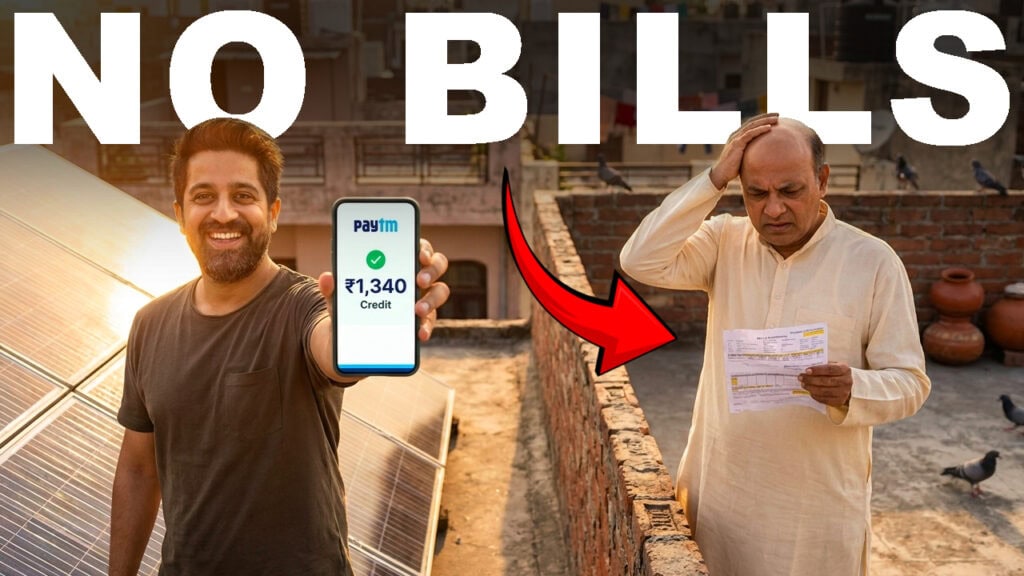
Article: Your neighbour could pay your electricity bill — and India just made it legal
Solar Energy · India Energy Stack · February 2026
Your neighbour could pay your electricity bill — and India just made it legal
A farmer in Meerut sold electricity to a shopkeeper in Delhi via WhatsApp. The transaction settled in under 2 seconds. This is not a pilot programme of the future. It happened in February 2026.
lumencity.in · Updated May 2026
Arun Singh grows wheat in Meerut, Uttar Pradesh. He also has rooftop solar panels. On a Tuesday afternoon in February 2026, his phone buzzed: a WhatsApp message from an AI voice agent asking if he wanted to sell 6 units of surplus electricity. He said yes. Lakshmi, a garment shop owner in Delhi, received those units within seconds. Arun earned ₹30. The entire transaction — generation, matching, settlement — took under 2 seconds.
That single exchange, barely worth the cost of a chai, is the most important thing to happen to India's electricity system in a decade. Because it proved something that policy documents had been promising for years: peer-to-peer energy trading in India is no longer a concept. It is live.
Why India's grid needed this
In 2025, India added 38 gigawatts of solar capacity — the second highest in the world in a single year. The result was paradoxical and infuriating. The national grid, struggling to absorb so much intermittent generation, had to switch off — curtail — 23 GW of clean power between May and November. Compensation payments to solar generators for electricity that was never used came to an estimated ₹575–690 crore.
At the same time, consumers in the same states were experiencing power cuts.
"We threw away enough clean electricity to avoid 2.1 million tonnes of CO₂ emissions — roughly the annual footprint of 4 lakh Indian households. Not because we generated too much. Because the grid did not know how to share it locally."
The root cause is structural. India's national grid was designed for a one-directional world: large thermal power plants push electricity outward to passive consumers. The infrastructure, the metering, the regulations — everything was built around that assumption. Rooftop solar broke it. Consumers became generators. Electricity wanted to flow in both directions. The grid was not ready.
Peer-to-peer trading is the architectural fix. Instead of excess solar struggling to enter an overloaded national transmission system, it gets consumed within the same neighbourhood — reducing curtailment, rewarding the producer, and cutting costs for the buyer.
How it actually works
The P2P trading process
You install rooftop solar and register a smart net meter with your DISCOM. This is your entry point into the trading network.
When your panels generate more than you consume, the surplus is listed automatically on the India Energy Stack digital trading platform.
A buyer — your neighbour, someone nearby, or even a consumer in another state — sees your listing and purchases the energy through a mobile app or WhatsApp interface.
The transaction settles automatically. Your earnings appear as a credit adjustment in your monthly electricity bill. No cash, no separate account — just a lower bill.
The price is negotiated between buyer and seller, not fixed by the DISCOM. Under the old net metering model, surplus power fed back to the grid earned a flat buyback rate — often ₹2–3 per unit, set by the utility. Under P2P trading, you set your own price. Evidence from the UP pilot shows buyers accessed electricity at up to 43% cheaper than the standard grid rate — which means sellers earned proportionally more than any fixed buyback would have offered.
What is live right now
Under the India Energy Stack framework launched by the Ministry of Power in June 2025, the first interstate P2P energy trading pilot is now operational across Delhi and western Uttar Pradesh.
The pilot covers approximately 1.25 crore consumers across three distribution companies, beginning with around 1,000 consumers per service area.
UPERC has waived Cross Subsidy Surcharge for energy transacted under the interstate pilot. Smart meters are mandatory for all participants.
To participate as a seller, you need a rooftop solar installation and a smart net meter. To participate as a buyer, you need a smart electricity meter. Both are registered as verified credentials — secure digital identities confirming you are a genuine DISCOM customer with verified metering and eligibility.
The bigger picture: internetification of the grid
P2P trading is one layer of a much larger shift. Energy experts are beginning to describe the destination as the "internetification of the grid" — a transformation analogous to what the internet did to telecommunications. Where once a single centralised exchange routed every call, the internet distributed that function across millions of nodes. Any one node could fail; the rest kept running.
India's current grid is the telephone exchange. Every home's solar panel, every smart meter, every battery storage unit is a potential node in the new network. Microgrids — clusters of homes sharing generation, storage, and local distribution — can operate independently if the main grid fails. Clusters of microgrids can support one another. A national blackout becomes structurally much harder to cause.
The physics of this transition are already in motion. What remains is the infrastructure, the regulation, and the awareness. The India Energy Stack is the regulatory layer. Smart meters — India has installed 5.28 crore so far against a target of 25 crore — are the sensing layer. Battery storage and microgrids are the resilience layer.
Your rooftop solar panels, in this picture, are not a cost-saving device. They are a node in a network. An asset that generates income while you sleep, travel, or simply go about your day — automatically, invisibly, and now, legally.
Sources: GRID-India via Business Standard (March 2026) · Ember Energy India Solar Report (January 2026) · EVReporter P2P Energy Trading Explainer (March 2026) · Energetica India (February 2026) · UPERC pilot approval via SolarQuarter (February 2026) · Outlook India — India Energy Stack (February 2026)