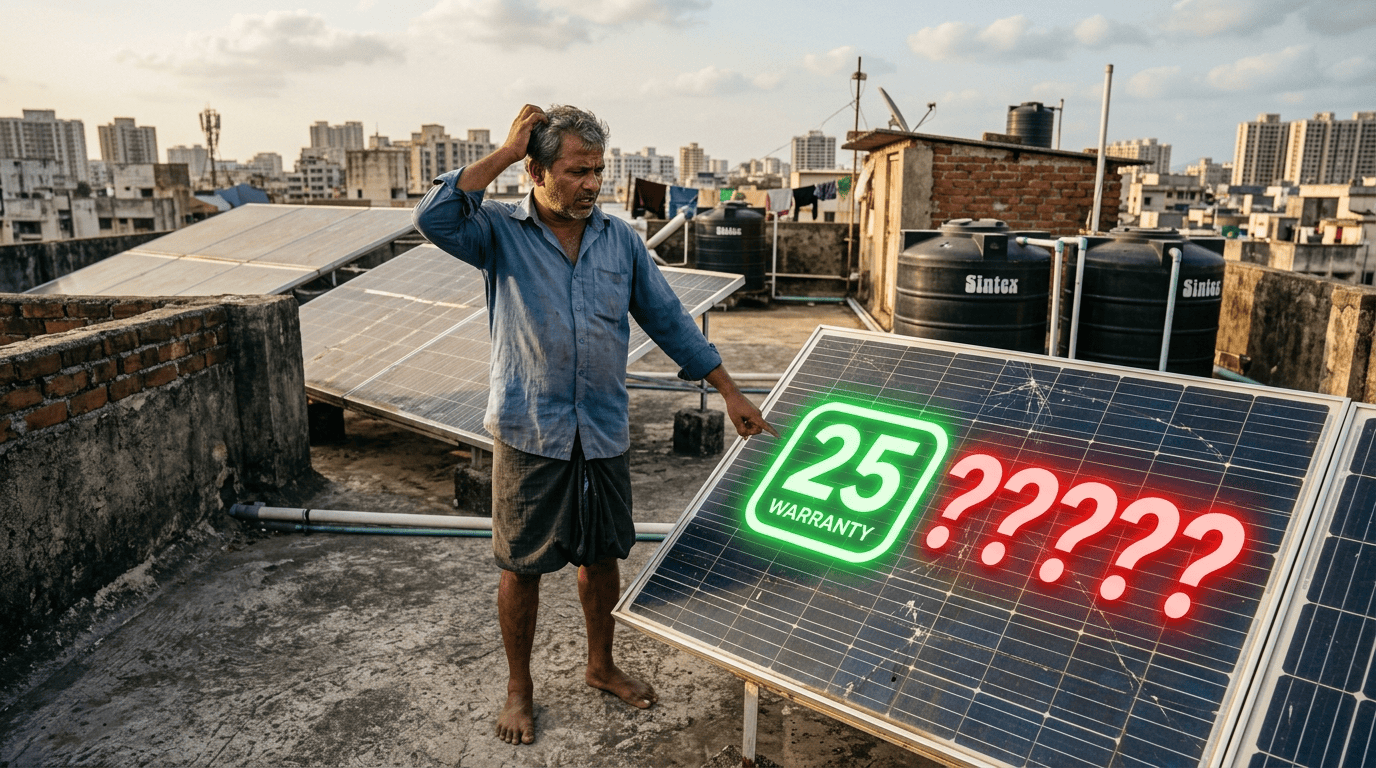
🔥 “25-Year Warranty” Doesn’t Mean What You Think
If you’ve ever looked into solar panels, you’ve probably heard this:
“25-year warranty hai… tension khatam.”
Sounds reassuring, right?
I used to think the same.
But once you dig deeper into how solar actually works—the science, the testing, and the business side—you realize:
👉 That “25 years” is not a simple promise.
👉 And it definitely doesn’t mean zero risk.
⚡ Where Did This 25-Year Warranty Come From?
This number isn’t random.
It actually traces back to one of the earliest solar applications:
👉 1958 — Solar panels used in satellites
These panels had to:
- Survive extreme radiation
- Operate without maintenance
- Last for years in space
Over time, this created a perception:
👉 Solar panels = extremely durable
And that’s true… but incomplete.
🧠 The First Big Misunderstanding
Most people assume:
👉 “25-year warranty = panel will work perfectly for 25 years”
That’s not how it works.
🔍 There Are TWO Different Warranties
This is where confusion starts.
🟢 1. Product Warranty (10–12 Years Typically)
This covers:
- Manufacturing defects
- Physical damage issues
- Material failures
👉 Think of this like a normal product guarantee
🔵 2. Performance Warranty (25 Years)
This is NOT about the panel “working” or “not working”.
👉 It’s about how much power it produces over time
Example:
- Year 1 → 100% output
- Year 25 → ~80–85% output
👉 That’s what the warranty promises
📉 Solar Panels Do Degrade (And That’s Normal)
This is another myth.
Panels don’t suddenly fail—they slowly lose efficiency.
Typical Degradation:
- First year: ~1–2% drop
- Every year after: ~0.4–0.7%
👉 After 25 years:
- Panel still works
- But at reduced capacity
🧪 What IEC Testing Actually Proves
Manufacturers often say:
👉 “IEC certified panels”
But what does that really mean?
IEC Tests Check:
- Heat resistance
- Humidity exposure
- Mechanical strength
- Long-term durability simulation
👉 Important:
These are accelerated tests, not real 25-year field proof.
⚠️ The Truth No One Talks About
Here’s the uncomfortable part:
👉 A 25-year warranty is only as strong as the company behind it.
Ask yourself:
- Will the company exist after 20 years?
- Will they honor claims easily?
- Will terms remain practical?
👉 This is where most buyers never look.
⚡ What About New Technologies? (TOPCon & HJT)
You’ve probably heard:
- TOPCon
- HJT
These are next-gen solar technologies.
Advantages:
- Higher efficiency
- Better low-light performance
- Potentially lower degradation
But Here’s the Catch:
👉 Long-term data is still evolving
Unlike older technologies, we don’t yet have:
👉 25–30 years of real-world proof
🧠 The One Question Even Experts Don’t Fully Answer
“Will solar panels actually last 25+ years reliably in all conditions?”
The answer is:
👉 Mostly yes… but not uniformly
Because performance depends on:
- Installation quality
- Climate conditions
- Maintenance
- Electrical design
⚡ The Bigger Mistake People Make
People focus too much on:
❌ Warranty years
And ignore:
✅ System design
✅ Installation quality
✅ Real usage
💡 What Actually Matters More Than Warranty
If you’re planning solar:
Focus on:
- Proper system sizing
- Correct installation
- Reliable components
- Practical usage
🧩 A Smarter Way to Think About Solar
Instead of:
👉 “Will this last 25 years?”
Think:
👉 “Will this reduce my electricity cost effectively over time?”
⚡ Where Most Homes Still Waste Power
Even after installing solar, many homes:
- Use inefficient lighting
- Waste electricity outdoors
- Overload systems unnecessarily
💡 Easy Way to Improve Overall Efficiency
Reducing load is just as important as generating power.
For example:
Instead of relying fully on grid or solar output for lighting,
you can explore efficient lighting solutions here:
👉 https://lumencity.in/solar-lights/
For specific applications:
- Street lighting for societies & outdoor areas
👉 https://lumencity.in/solar-lights/solar-street-lights/ - Flood lighting for terraces & buildings
👉 https://lumencity.in/product-category/solar-lights/solar-flood-lights/ - Garden lighting for homes
👉 https://lumencity.in/solar-lights/solar-garden-lights/
👉 This reduces overall load and improves system efficiency
🔚 Final Thought
Solar panels are reliable.
But the idea of:
👉 “Install once, forget for 25 years”
Is not entirely true.
The real truth is:
👉 Solar works best when you understand it—not just trust numbers.
❓ FAQs
1. Do solar panels really last 25 years?
Yes—but with reduced efficiency over time.
2. What is more important: product or performance warranty?
Both—but product warranty protects you more directly.
3. Are new technologies like TOPCon better?
Yes in theory—but long-term data is still developing.
4. Should I rely only on warranty when buying solar?
No—installation and system design matter more.