🔥 Before AC Existed, People Still Stayed Cool
Today, the moment temperature crosses 40°C, we switch on the AC.
But here’s something most people never think about:
👉 Civilizations survived extreme heat thousands of years ago—without electricity.
No compressors.
No refrigerants.
No ₹5,000 electricity bills.
So how did they do it?
And more importantly—
👉 Can these techniques still work in India today?
🌬️ 1. Wind Catchers (Badgirs) — The Original Air Conditioners
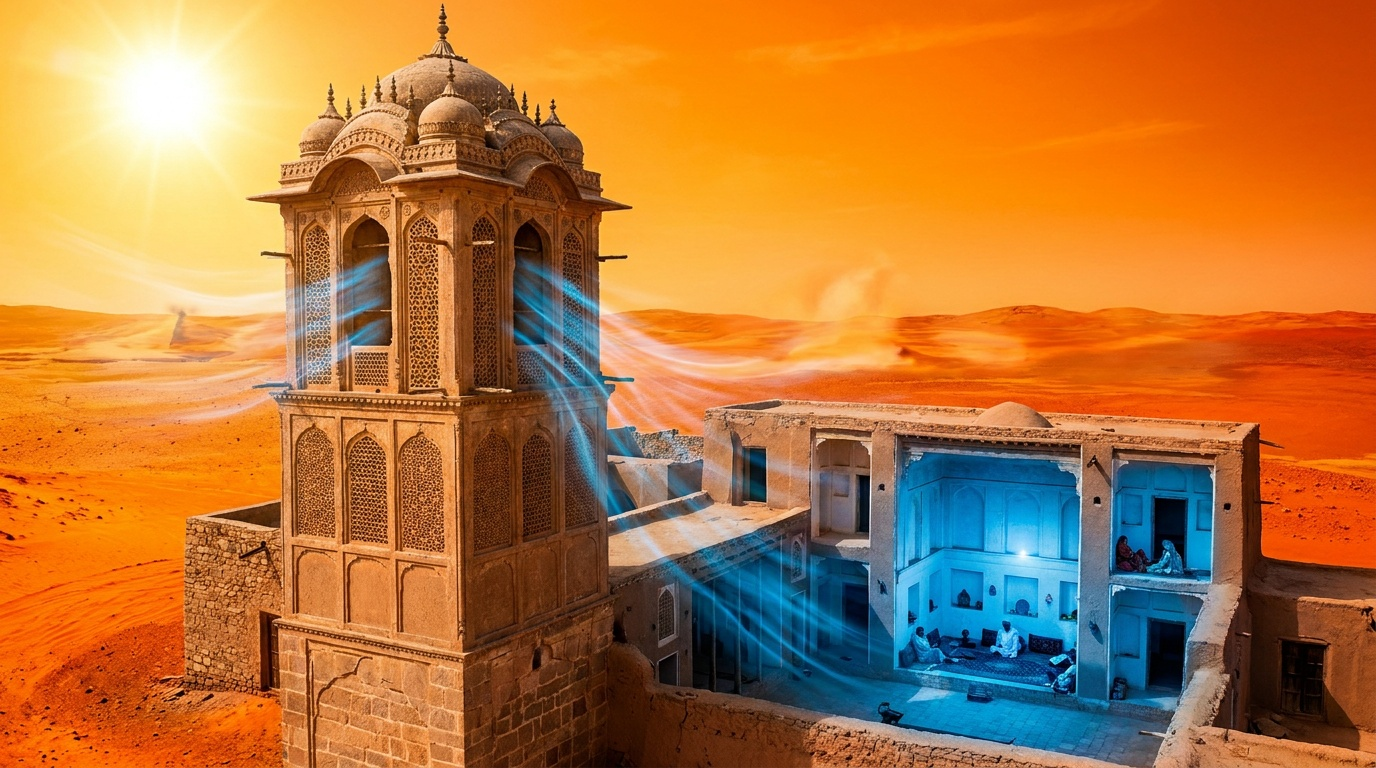
Long before modern HVAC systems, Persian architects built wind catchers, also known as Badgirs.
These tall towers were designed to:
- Capture wind at higher altitudes
- Direct it downward into homes
- Push hot air out
⚙️ How It Worked
- Wind enters the tower
- Gets funneled into living spaces
- Hot air exits through other openings
👉 Result: Continuous airflow + natural cooling
🌡️ Why It Was Effective
Air at higher levels is:
- Cooler
- Faster moving
By controlling airflow direction, these structures created natural ventilation systems.
👉 Even today, this concept is used in modern passive cooling architecture.
💧 2. Abanbars — Cooling Through Water Storage
Ancient Iran didn’t just store water.
👉 They used it to cool entire environments.
What Were Abanbars?
- Underground water storage systems
- Built with thick insulated walls
- Often connected with wind catchers
Cooling Mechanism:
- Underground temperature remains stable
- Water absorbs surrounding heat
- Air passing over it cools down
👉 This cooled not just water—but nearby buildings too
🏛️ 3. Passive Cooling Architecture — Smart Design, Not Smart Devices
Ancient buildings were not random.
They were engineered for climate.
Key Features:
- Thick walls (thermal insulation)
- Courtyards (air circulation)
- Small openings (controlled sunlight)
- Orientation based on sun direction
In India, You’ve Already Seen This:
- Stepwells (Baolis)
- Old havelis
- Traditional village homes
👉 These weren’t just aesthetic choices
👉 They were functional cooling systems
❄️ 4. Ice in the Desert? Yes—Yakhchals Made It Possible
This sounds unbelievable—but it’s real.
Ancient Persians built Yakhchals:
- Dome-shaped structures
- Deep underground storage
- Thick insulated walls
How They Made Ice:
- Used night-time cooling
- Combined evaporation + insulation
- Stored ice in underground chambers
👉 Ice… in desert climates… without electricity
🇮🇳 Why These Techniques Matter in India Today
Let’s connect this to reality.
India is facing:
- Increasing heatwaves
- Rising electricity demand
- Overdependence on AC systems
👉 The problem is not just heat
👉 It’s how we respond to it
⚡ The Modern Mistake: Solving Everything With AC
Most homes today:
- Ignore airflow
- Ignore insulation
- Ignore passive cooling
Instead:
👉 Add more AC units
Result:
- Higher electricity bills
- Overloaded systems
- Increased dependency
🧠 The Smart Approach: Combine Old + New
Ancient systems alone are not enough today.
But combined with modern solutions—they become powerful.
💡 Example:
Instead of:
❌ AC + high electricity usage
Use:
✅ Passive cooling + efficient systems
⚡ Where You Can Start Today
Even if you don’t build wind catchers or abanbars:
👉 You can still reduce energy load significantly
Step 1: Improve Airflow & Design
- Cross ventilation
- Shade control
- Reduced heat absorption
Step 2: Reduce Electricity Load
Most people ignore this:
👉 Lighting consumes more than expected
Instead of running outdoor lighting on grid power:
Explore energy-efficient alternatives here:
👉 https://lumencity.in/solar-lights/
For different use cases:
- Outdoor areas & streets
👉 https://lumencity.in/solar-lights/solar-street-lights/ - Large open spaces & terraces
👉 https://lumencity.in/product-category/solar-lights/solar-flood-lights/ - Garden & decorative lighting
👉 https://lumencity.in/solar-lights/solar-garden-lights/
👉 These reduce dependency on electricity without compromising functionality
🔮 The Future of Cooling Isn’t More Power — It’s Smarter Design
The biggest shift happening globally:
❌ From: Energy-heavy cooling
✅ To: Passive + efficient systems
Ancient techniques are not outdated.
👉 They are underutilized
🔚 Final Thought
Your ancestors didn’t have electricity.
But they had something more powerful:
👉 Understanding of climate + design
Today, you have:
- Technology
- Energy solutions
- Better materials
The smartest homes of the future will combine both:
👉 Ancient wisdom + modern efficiency
❓ FAQs
1. Can ancient cooling methods work today?
Yes, especially when combined with modern systems.
2. Can I build a wind catcher in India?
Possible in new constructions with proper design.
3. Do passive cooling techniques reduce AC usage?
Yes, significantly.
4. What is the easiest way to reduce cooling cost today?
Reduce electricity load + improve airflow + use efficient systems.