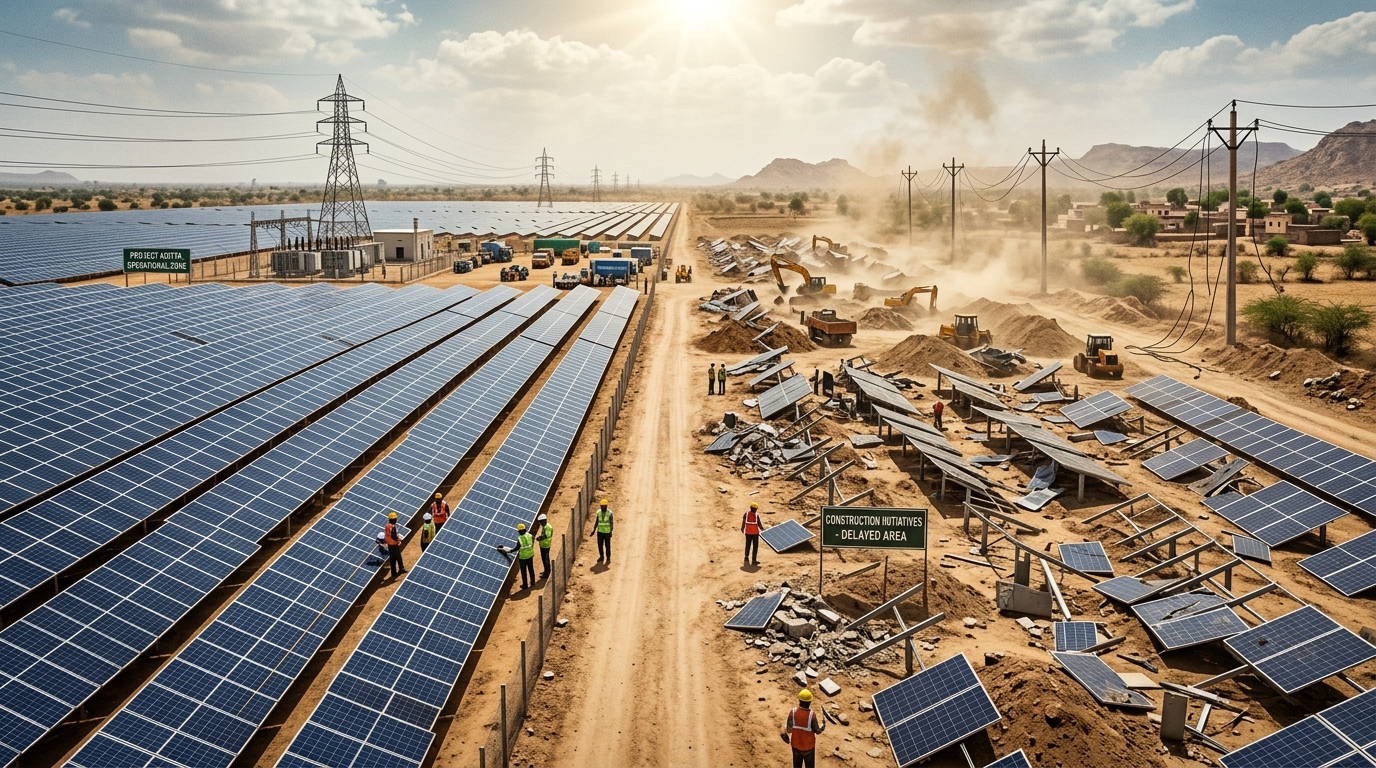
🔥 The Truth No One Tells You About Solar Farms
On paper, almost every solar farm looks profitable.
- Free sunlight
- Government schemes
- Long-term returns
But here’s the reality:
👉 Most solar farm projects in India fail before construction even begins.
Not because solar doesn’t work—
but because the project was flawed from day one.
At Lumencity, nearly 80% of solar farm proposals are rejected.
Not for lack of interest.
But because the fundamentals simply don’t make sense.
⚠️ Solar Farm ≠ Rooftop Solar
This is the biggest misconception.
Many investors assume:
“If rooftop solar works, solar farms must be even better.”
That’s not how it works.
Rooftop Solar:
- Installed on existing structure
- Minimal land concerns
- Lower infrastructure cost
Solar Farms:
- Require large land parcels
- Depend on grid infrastructure
- Involve heavy civil + electrical work
👉 A solar farm is not just a system.
👉 It’s a full-scale infrastructure project.
🚫 Why 80% of Projects Get Rejected
Let’s break down the real reasons.
1. 📍 Distance From Substation (Deal Breaker)
This is the #1 reason projects fail.
If your land is far from a substation:
- Transmission cost increases massively
- Permissions become difficult
- Project viability drops
👉 In many cases, this alone kills the project.
2. 🧭 Land Shape & Size
Not all land is usable.
Problems we often see:
- Irregular shapes
- Fragmented plots
- Insufficient area
For a 1 MW solar farm, you typically need:
👉 ~4–5 acres of usable land
But more important than size is:
👉 how efficiently panels can be laid out
3. ⚡ Grid Availability & Evacuation
Even if everything else is perfect…
👉 If power cannot be evacuated, the project is useless.
Key challenges:
- Limited grid capacity
- Approval delays
- Technical constraints
4. 🔌 Transmission Line Complexity
This is where most “profitable” projects collapse.
You need:
- Routing from site to substation
- Right-of-way permissions
- Poles, cabling, infrastructure
👉 This is not just technical—it’s bureaucratic.
5. 🏗️ Hidden Infrastructure Costs
This is where reality hits hardest.
Most proposals ignore these completely.
💰 Real Cost Components (1 MW Solar Farm)
A proper solar farm isn’t just panels.
You must factor in:
- Boundary wall & fencing
- Internal roads
- Water pipelines for cleaning
- Underground & overhead cabling
- Step-up transformers
- Transmission line setup
- SCADA & monitoring systems
- Land leveling & development
👉 These costs are often underestimated or ignored entirely
📉 Real ROI vs Brochure ROI
Let’s talk honestly.
What brochures say:
- 3–4 year returns
- High profitability
- Low risk
Real scenario:
- 5–7 year ROI (sometimes more)
- Delays in approvals
- Generation variability
- Maintenance costs
👉 Solar farms are long-term assets, not quick-return investments
🏛️ PM KUSUM Yojana — Opportunity With Conditions
Schemes like PM KUSUM have created interest in solar farms.
But they also bring:
- Strict compliance
- Grid limitations
- Competitive approvals
👉 Not every project qualifies—even if land is available
🧠 What Actually Makes a Solar Farm Successful
After evaluating hundreds of projects, the success factors are clear:
✅ Ideal Conditions:
- Land near substation
- Proper land shape
- Strong grid availability
- Clear transmission route
- Realistic budgeting
👉 Miss even one of these—and risk increases significantly.
👤 Who Should Invest in Solar Farms?
Let’s be very clear.
👍 Suitable for:
- Long-term investors
- Landowners near substations
- EPC professionals
- Businesses with patient capital
👎 Not suitable for:
- Short-term profit seekers
- Investors expecting quick returns
- Poorly researched land buyers
👉 Solar farms are powerful—but only when done right.
⚡ Smarter Entry Into Solar (For Most People)
If you’re exploring solar for savings or smaller investments:
👉 Start with distributed solutions instead of jumping into utility-scale projects.
For example, explore practical solar applications here:
👉 https://lumencity.in/solar-lights/
For real-world use cases:
- Street lighting for farms & communities
👉 https://lumencity.in/solar-lights/solar-street-lights/ - Flood lighting for large open areas
👉 https://lumencity.in/product-category/solar-lights/solar-flood-lights/ - Garden & landscape lighting
👉 https://lumencity.in/solar-lights/solar-garden-lights/
👉 These solutions are easier to deploy and deliver immediate value.
🔚 Final Thought
Solar farms don’t fail because solar is bad.
👉 They fail because the fundamentals are ignored.
At Lumencity, rejecting 80% of projects isn’t a weakness.
👉 It’s discipline.
Because in solar infrastructure:
❌ Bad projects cost crores
✅ Good projects generate decades of returns
❓ FAQs
1. How much land is required for a solar farm?
Typically 4–5 acres per MW, depending on layout.
2. What is the biggest risk?
Distance from substation and grid availability.
3. Is solar farming profitable in India?
Yes—but only with correct planning and execution.
4. What is the ROI timeline?
Usually 5–7 years in realistic scenarios.