
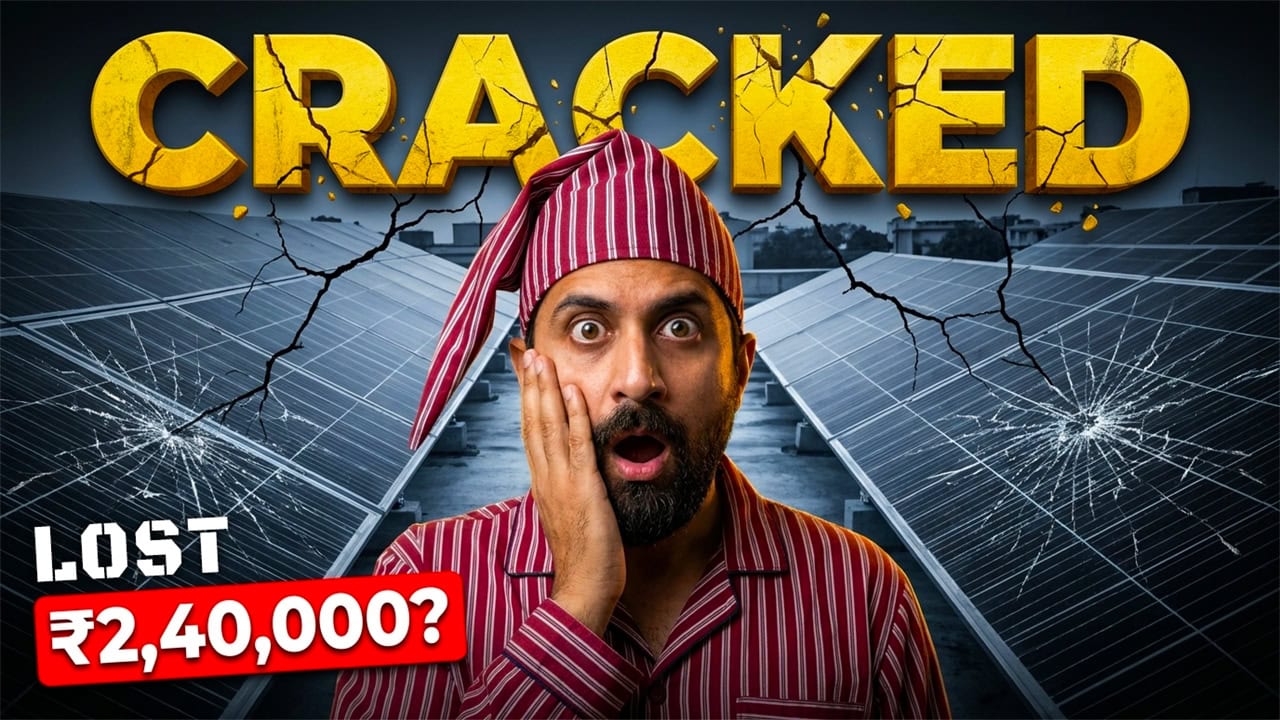
Why Are Solar Panels Made After 2026 Cracking More? The Kiwa PVEL 2026 Report, Explained for India
By the Lumencity Team · Updated June 2026 · 7 min read
Solar panels are cheaper and more advanced than ever — so why are the latest ones cracking and failing at record rates? The world’s most-cited independent solar testing lab, Kiwa PVEL, just published its 2026 reliability data, and the findings are a wake-up call for every Indian homeowner and business planning a solar installation.
In its 2026 PV Module Reliability Scorecard, Kiwa PVEL reported that 87% of the manufacturers it tested had at least one module fail a reliability test — the highest figure ever recorded, and up from roughly 50% just four years earlier. The two biggest problem areas were mechanical breakage and delamination, both at new highs.
This guide breaks down — in plain language — why newer solar panels are more fragile, what is really driving the quality drop, which solar brands performed best in India, and exactly how to protect yourself before you buy.
87%of manufacturers had at least one test failure (2026)
45%had a major delamination defect
~50%→87%failure rate rise in just 4 years
What is the Kiwa PVEL Scorecard — and why should Indian buyers care?
Kiwa PVEL is an independent laboratory that puts solar modules through an extended “torture test” far tougher than the basic certification panels need to be sold. Manufacturers voluntarily submit their modules, which are then graded across eight stress sequences: Thermal Cycling, Damp Heat, Mechanical Stress, Hail Stress, Potential Induced Degradation (PID), UV Induced Degradation (UVID), Light Induced Degradation (LID), and PAN energy-yield simulation.
A “Top Performer” badge in any test means the module’s power loss stayed within Kiwa PVEL’s safe threshold for that test. It is one of the few neutral, money-can’t-buy quality signals in the solar industry — which is why developers, banks and informed homeowners use it. The 2026 edition assessed 246 module entries from factories across nine countries, with India now the second-largest participant after China.
Why were older solar panels more durable?
Two physical things have changed, and together they explain most of the cracking problem.
1. Panels became much bigger
Older modules were compact 60-cell and 72-cell designs. Today’s panels use larger wafer formats (182 mm and 210 mm) and 144 half-cells, pushing wattage to 400 W, 500 W and beyond. At the same time, the silicon cells inside have been shaved thinner — many are now under 0.2 mm thick, roughly the width of a few human hairs.
A larger sheet of glass with thinner cells behaves like a big tabletop: it flexes more in the middle under wind, hail, snow load, or careless handling during transport and installation. That flex creates microcracks inside the cells — invisible to the naked eye.
2. Frames, glass and materials became thinner
The aluminium frame is the skeleton of a panel. Compare a five-year-old panel’s frame with a new one and you will often feel the difference — the newer frame is lighter, because it uses less aluminium. Manufacturers have also moved from 3.2 mm glass towards 2 mm glass and trimmed the protective encapsulant, especially at the edges.
Kiwa PVEL was blunt about the link: cost-and-efficiency moves such as thinner frames, thinner encapsulants and zero-busbar designs are directly associated with higher degradation and failure risk. A thinner frame bends and twists more easily, and a gap at a frame corner is a common starting point for glass breakage.
Why a microcrack is so dangerous: a microcrack rarely cuts power immediately. It spreads slowly over months and years into a “dead zone”, which can become a hotspot — a point that heats up abnormally and, in extreme cases, becomes a fire risk. The damage is silent until it is serious.
How does the price drop of solar panels affect quality?
None of this is an accident — it is survival. A brutal global price war pushed module prices down to roughly USD 0.07–0.09 per watt, often below the cost of making them. In just the first half of 2025, six large Chinese manufacturers together lost an estimated USD 2.8 billion.
When every panel sold loses money, the only way to survive is to cut material from every layer — thinner glass, thinner frames, less encapsulant, thinner cells. Each gram and millimetre saved protects the manufacturer’s margin, but it quietly removes the safety buffer that kept older panels alive for 25 years.
The India reality: defect rates among the highest globally
For Indian buyers the picture demands extra caution. Independent pre-shipment inspection data has placed India’s solar module defect rates among the highest in the world, with the most common issues being cell cracking, frame-material problems and assembly defects — exactly the failure modes described above. In one real incident, a storm of only 120 km/h tore apart low-quality panels and turned them into flying debris. Remember: when a panel fails badly, the resulting damage can cost up to ten times the price of the panel itself.
India solar brand leaderboard — Kiwa PVEL 2026
Here is the good news. India now has a credible top tier. The fair way to rank brands is by their average number of Top Performer designations per submitted model, out of 8. Importantly, no module anywhere in the world scored a perfect 8/8 in 2026.
| Rank | Brand | Avg score (out of 8) |
|---|---|---|
| 1 | Adani Solar | 6.5 |
| 2 | Grew Solar | 6.0 |
| 2 | ReNew | 6.0 |
| 4 | RenewSys | 5.75 |
| 5 | Waaree | 3.13 |
A fair word on Waaree: its lower average is not a sign of poor quality. Waaree submitted 23 models — the largest roster of any Indian manufacturer — including tough large-format and bifacial variants where the thresholds are hardest to meet. Its best models still scored 6 out of 8.
The three best individual Indian modules tied for the global best score of 7 out of 8: Adani Solar’s ASB-M10-144-AAA, ReNew’s RPS2MH72BD series, and RenewSys’s DESERV EXTREME 144X — all n-type TOPCon designs. Other brands that earned Top Performer status in one or more tests include EMMVEE, Goldi Solar, Avaada Electro, Gautam Solar, Rayzon Solar, Vikram Solar, Solex and Tata Power Solar.
Two honest weak spots remain for Indian-made panels: in hail testing, the best Indian result was 45 mm (none reached the 50–55 mm levels some Chinese panels cleared), and in mechanical load, very few reached the highest stress levels. If you live in a high-snow or heavy-hail region, check the exact model carefully.
What about the 25-year warranty?
A 25-year warranty only has value if two things are true: the panel is built to actually last that long, and the company will still exist to honour the claim. In a market where manufacturers are losing billions and cutting material to survive, both assumptions deserve scrutiny. Always read the warranty’s fine print — performance warranty versus product warranty are different things — and favour established brands with a track record and a real service presence in India.
Which solar panel should you choose? A 5-point buyer checklist
- Do not buy on price-per-watt alone. The cheapest quote almost always means material has been cut somewhere. Solar is a 25-year decision.
- Ask for the EL (electroluminescence) test report. It reveals the microcracks you cannot see. If a seller cannot provide one, that is your answer.
- Verify certifications. Look for BIS, IEC 61215 and IEC 61730, plus ALMM listing for subsidy-linked projects. These are your insurance, not marketing labels.
- Inspect the frame and glass yourself. A solid, well-anodised frame with no corner gaps and adequate glass thickness is a strong quality signal. Be wary of unusually light frames.
- Check who stands behind the brand. Demand the flash-test report and clear warranty terms, and choose a brand with genuine after-sales support.
Confused about which solar is genuinely safe for your home or business?
At Lumencity, our philosophy is simple — not the cheapest solar, the right solar. We are a BIS-certified solar and LED lighting brand, and we help you choose reliable, properly tested products that last the full 25 years.Talk to a Lumencity Solar Expert
Frequently Asked Questions
Are solar panels made after 2026 really cracking more? Independent testing shows reliability has dropped over recent years, with mechanical breakage and delamination at record highs in the Kiwa PVEL 2026 report. The trend is driven by larger panel formats and cost-cutting on materials such as frames, glass and encapsulant. Which solar panel brand is best in India in 2026? In the Kiwa PVEL 2026 reliability test, Adani Solar led Indian brands with an average of 6.5 out of 8, followed by Grew Solar and ReNew (6.0 each) and RenewSys (5.75). The single best Indian modules came from Adani, ReNew and RenewSys, each scoring 7 out of 8. What is a microcrack and is it dangerous? A microcrack is a tiny fracture inside a solar cell, often invisible. It usually does not reduce power immediately but can spread over time into a dead zone and then a hotspot, which in extreme cases poses a fire risk. How can I check if a solar panel is good quality before buying? Ask for the electroluminescence (EL) test report, verify BIS, IEC 61215, IEC 61730 and ALMM listings, inspect the frame and glass, and avoid choosing purely on the lowest price per watt. Is a cheap solar panel worth it? Usually not. A very low price often means thinner materials and a higher failure risk. Because a failed panel can cost up to ten times its own price in damage and replacement, cheap panels frequently cost more over the system’s life.
Sources
Kiwa PVEL — 2026 PV Module Reliability Scorecard (12th edition); Saur Energy — Kiwa PVEL 2026 India analysis; PV Magazine India & Energetica India — 2026 Top Performer coverage; Mercom India — Indian module defect-rate report; Wood Mackenzie / industry pricing data on module price war. Figures are summarised for general information and may be updated as new data is released.