
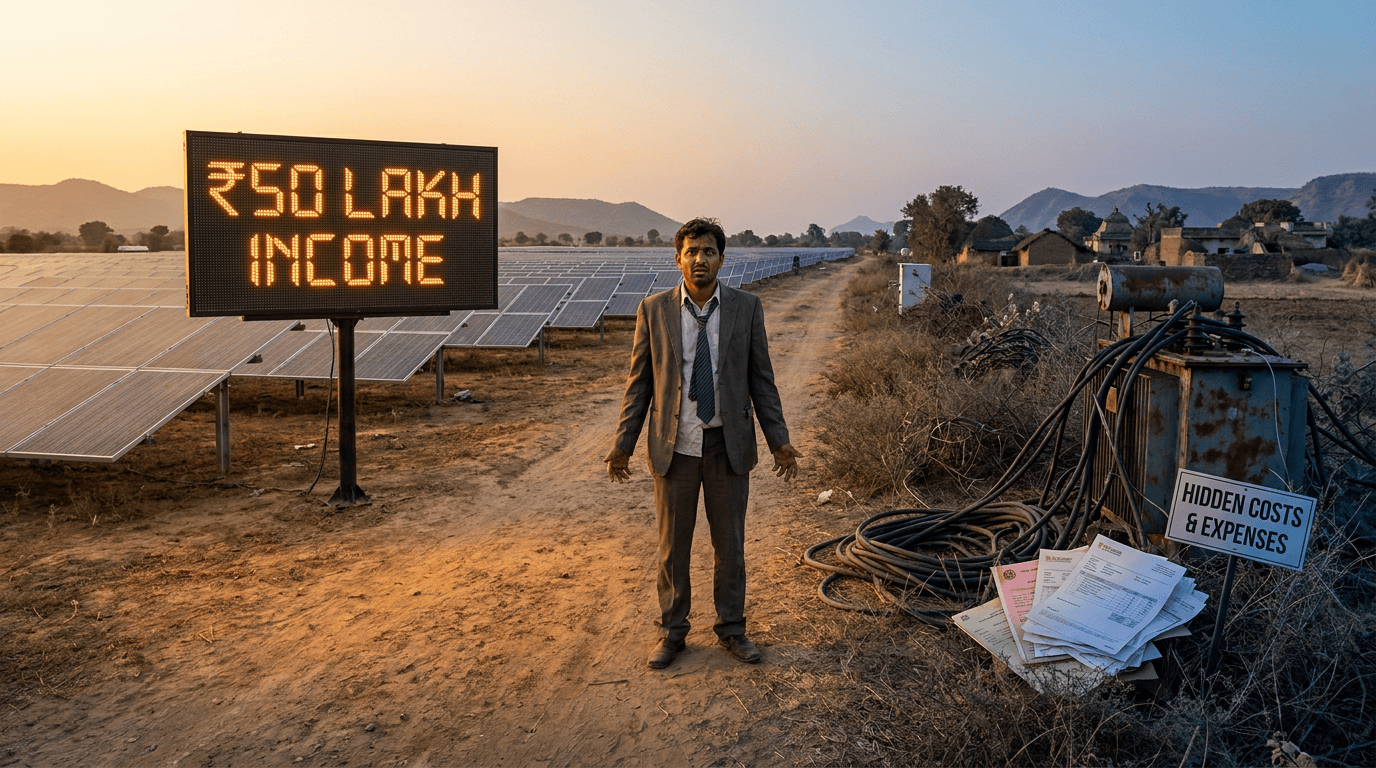
🔥 “₹50 Lakh Income from Solar?” — Sounds Too Good to Be True
If you’ve been researching solar farms, you’ve probably seen claims like:
“Earn ₹50 lakh from a solar farm”
“Passive income for 25 years”
“Government-backed guaranteed returns”
It sounds like a perfect investment.
But here’s the reality:
👉 Yes, earning ₹50 lakh is possible…
👉 But not the way most people think.
⚡ First, Understand What People Actually Mean
When someone says:
👉 “₹50 lakh from solar”
They usually mean:
- Total revenue over years
- Not monthly income
- Not guaranteed profit
👉 That’s the first misunderstanding.
🏛️ What is PM KUSUM Yojana?
PM KUSUM is a government scheme designed to:
- Promote solar farming
- Allow farmers to generate income
- Reduce dependency on diesel
It offers:
- Subsidy support
- Long-term power purchase agreements
- Structured bidding process
👉 Sounds ideal—but execution is not simple.
🌾 Land Requirement: The First Barrier
To set up a solar farm:
👉 You need 4–5 acres per MW
But not just any land:
- Must be near substation
- Must have grid connectivity
- Must be technically viable
👉 This eliminates most available land
⚡ The Biggest Reality: Grid & Substation Dependency
Even if you have land:
👉 If power cannot be evacuated → project fails
Key challenges:
- Limited grid capacity
- Distance from substation
- Approval delays
👉 This is where most projects collapse
💰 Real Cost of a Solar Farm (1 MW Example)
Let’s break it down honestly.
Major Components:
- Solar panels
- Inverters
- Mounting structure
- Transmission line
- Step-up transformer
- Civil work
- SCADA monitoring
💸 Approx Total Cost:
👉 ₹4 – ₹6 crore per MW
👉 This is far higher than what most videos suggest
📉 So Can You Earn ₹50 Lakh?
Let’s calculate realistically.
Annual Revenue (Approx):
👉 ₹40–₹60 lakh per year (before expenses)
But subtract:
- O&M costs
- Land costs
- Transmission losses
- Loan interest
👉 Net income drops significantly
ROI Timeline:
👉 5–8 years (in real scenarios)
👉 So yes, ₹50 lakh is possible—but:
- Not immediate
- Not guaranteed
- Not risk-free
⚠️ The Long-Term Challenges
Most people only look at installation.
They ignore:
🔻 1. Maintenance Costs
- Cleaning
- Repairs
- Monitoring
🔻 2. Generation Variability
- Weather changes
- Seasonal impact
🔻 3. Policy Changes
- Tariff adjustments
- Regulatory shifts
👉 These affect long-term returns
🧠 Who Should Actually Invest?
Let’s be brutally honest.
👍 Ideal for:
- Long-term investors
- Landowners near substations
- Businesses with capital
- EPC professionals
👎 Not for:
- Small investors expecting quick returns
- People without technical understanding
- Buyers influenced by “high return” claims
👉 Solar farms are not passive income machines
👉 They are infrastructure investments
⚡ A Smarter Entry Point for Most People
If your goal is:
👉 Reduce electricity bills
👉 Enter solar space
Then jumping into a ₹4–₹6 crore project is not necessary
💡 Practical Solar Applications
Instead of large-scale farms:
Explore smaller, practical solutions here:
👉 https://lumencity.in/solar-lights/
For real-world use:
- Street lighting for farms & societies
👉 https://lumencity.in/solar-lights/solar-street-lights/ - Flood lighting for open land & warehouses
👉 https://lumencity.in/product-category/solar-lights/solar-flood-lights/ - Garden & decorative lighting
👉 https://lumencity.in/solar-lights/solar-garden-lights/
👉 These deliver immediate ROI without massive investment
🔚 Final Thought
Solar farming is powerful.
But it’s not:
❌ Easy money
❌ Guaranteed income
❌ Risk-free investment
It is:
✅ Long-term
✅ Capital-intensive
✅ Highly dependent on execution
👉 The real question is not:
“Can I earn ₹50 lakh?”
👉 It is:
“Do I have the right conditions to make this work?”
❓ FAQs
1. Can I really earn ₹50 lakh from a solar farm?
Yes—but over time and under correct conditions.
2. What is the minimum investment?
₹4–₹6 crore per MW (approx).
3. Is PM KUSUM profitable?
Yes—but depends heavily on location and execution.
4. What is the biggest risk?
Grid connectivity and project feasibility.
3 acre my land