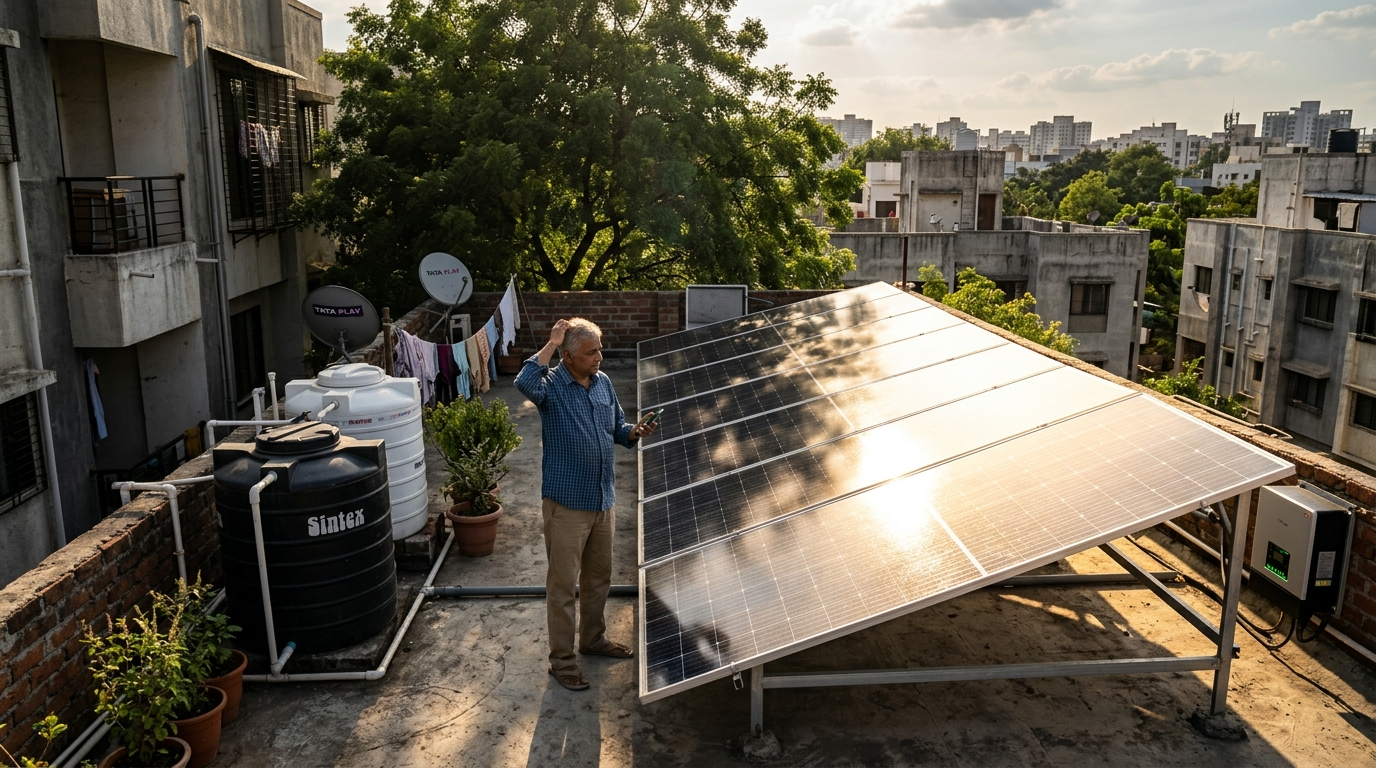
🔥 “Install Solar and Save Money” — Sounds Simple, Right?
That’s what most people believe:
👉 Install panels → generate electricity → save money
Done.
But here’s the uncomfortable truth:
👉 Not every home should install solar.
And in some cases:
👉 A badly planned system can quietly waste lakhs of rupees over time.
⚠️ The Problem No One Talks About
Most solar discussions focus on:
- Panel efficiency
- Cost per kW
- Subsidy
But almost nobody talks about:
👉 Roof conditions
Because even a perfect solar system can fail if:
👉 Your roof is wrong.
⚡ The Physics Behind Solar Failure
Solar panels work best when:
- They receive consistent sunlight
- There are no obstructions
- Energy flow remains uniform
💣 Here’s What Most People Don’t Know
👉 Even a single shadow on one panel can affect the entire system.
Why?
Because panels are connected in series.
Example:
- One panel shaded → reduced output
- Entire string performance drops
👉 This is not a small loss—it compounds daily
🚫 Category 1: Roofs with Tree Shadows
This is the most common issue.
Problem:
- Trees grow over time
- Shadow increases gradually
- Output keeps decreasing
👉 What looks fine today may become a problem in 2–3 years
🚫 Category 2: Nearby Buildings Blocking Sunlight
Urban India is evolving fast.
New buildings = new shadows.
Problem:
- Tall structures block sunlight
- Seasonal sun angle changes impact exposure
👉 Your system may work in summer…
👉 but fail in winter months
🚫 Category 3: Shared Roof Ownership (Apartments)
This is rarely discussed.
Problem:
- Multiple owners
- Disputes over space
- Limited installation area
👉 Solar becomes complicated legally and practically
🚫 Category 4: Wrong Roof Orientation
This is a technical but critical factor.
Ideal:
👉 South-facing roofs (in India)
Problem:
- East/West-facing roofs → reduced efficiency
- North-facing → major loss
👉 You still generate power—but far less than expected
💣 The Hidden Cost of Ignoring These Factors
Let’s say you invest:
👉 ₹3–6 lakh in a solar system
If conditions are wrong:
- Generation drops
- ROI increases
- Payback gets delayed
👉 In some cases, system never performs as expected
🧠 So… Who Should NOT Install Solar?
Let’s be clear.
❌ Avoid solar if:
- Heavy or growing shadows exist
- Future construction risk is high
- Roof ownership is unclear
- Orientation is highly unfavorable
👉 In these cases, solar becomes a poor investment
⚡ But That Doesn’t Mean You Can’t Save Electricity
This is where most people make a mistake.
They think:
❌ “If solar doesn’t work, nothing works”
👉 That’s not true.
💡 Smarter Alternatives for Most Homes
Even without rooftop solar, you can:
👉 Reduce electricity dependency significantly
Step 1: Cut Load First
Instead of focusing only on generation:
👉 Reduce consumption
Most homes waste energy in:
- Outdoor lighting
- Security lighting
- Common area lighting
⚡ Practical Solution That Works Everywhere
Unlike solar panels, some systems don’t depend on roof conditions.
Explore practical solar-based lighting solutions here:
👉 https://lumencity.in/solar-lights/
For specific use cases:
- Street lighting for homes & societies
👉 https://lumencity.in/solar-lights/solar-street-lights/ - Flood lighting for terraces & parking
👉 https://lumencity.in/product-category/solar-lights/solar-flood-lights/ - Garden lighting
👉 https://lumencity.in/solar-lights/solar-garden-lights/
👉 These work independently and reduce electricity bills directly
🔄 What About Shadow-Free Solar Technologies?
There are newer solutions like:
- Micro-inverters
- Power optimizers
What They Do:
- Reduce impact of shading
- Improve partial performance
But:
👉 They don’t eliminate the problem completely
👉 They increase system cost
🔚 Final Thought
Solar is powerful.
But only when:
👉 Conditions are right
The biggest mistake people make:
❌ Installing solar blindly
The smartest move:
✅ Understanding your roof first
Because in solar:
👉 Right decision saves money
👉 Wrong decision wastes it silently
❓ FAQs
1. Can solar work with some shadow?
Yes—but performance drops significantly.
2. What is the best roof for solar?
South-facing, shadow-free roof.
3. Can I fix shading issues later?
Sometimes—but often expensive.
4. What if my roof is not suitable?
Focus on reducing electricity load instead.