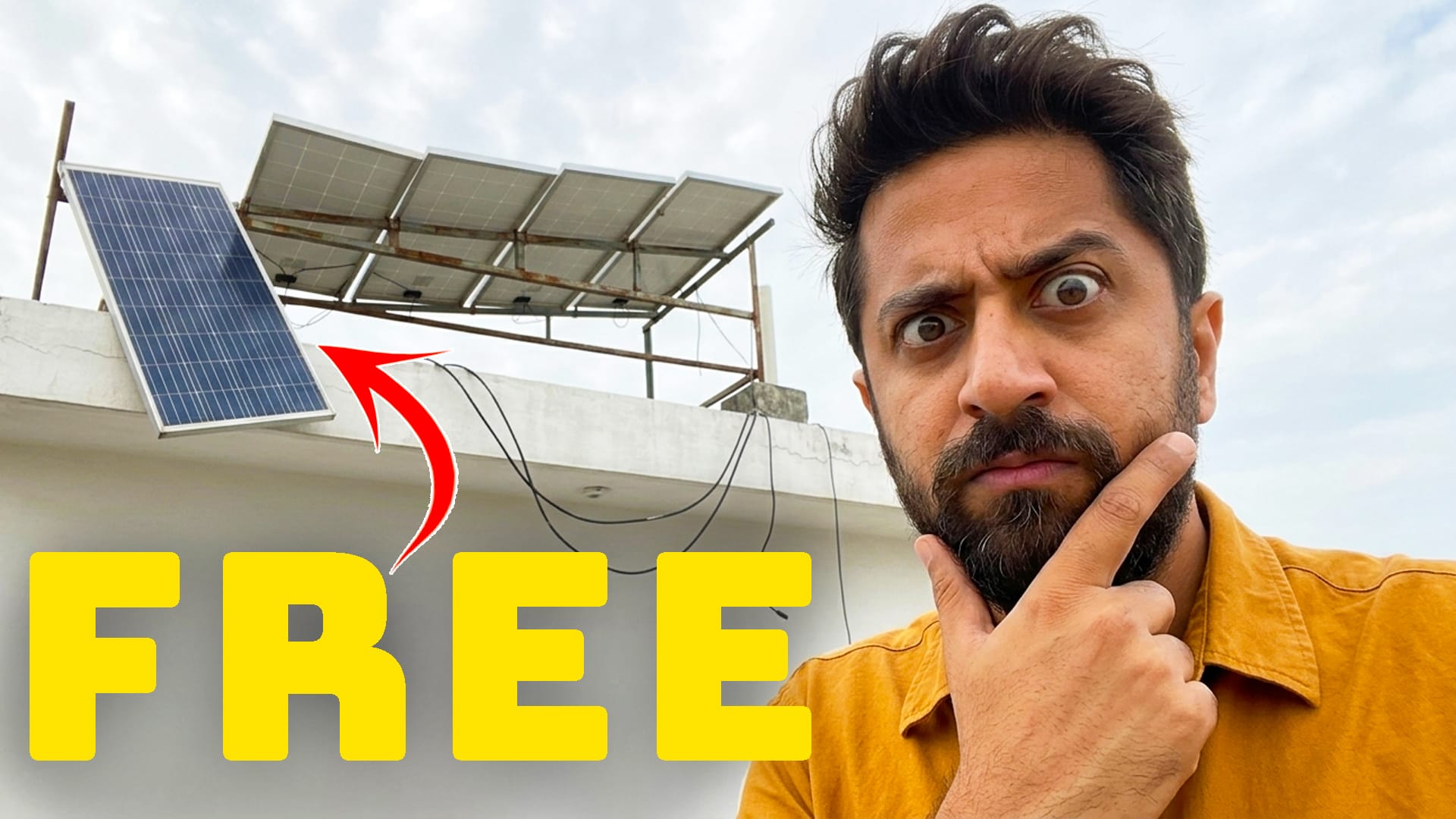
Delhi Free Rooftop Solar Scheme 2026: Eligibility, Cost and How to Apply
Delhi plans free rooftop solar for 2,20,000 homes under a 605 MW programme. Here is who qualifies, what you pay, what the draft tender actually demands from installers, and how to check your eligibility in under a minute.
Last updated: 19 September 2026 · By Lumencity, Delhi rooftop solar installers since 2014
The scheme in short
The Delhi government, through IPGCL and the Delhi DISCOMs, plans to install rooftop solar on domestic connections at little or no cost to the household. Instead of every family finding its own installer, the government bundles thousands of homes together and appoints vendors through a competitive tender. This approach is called Utility-Led Aggregation (ULA), and it is a national model under PM Surya Ghar, not a Delhi-only idea.
For an eligible household the promise is simple: a 2 kW or 3 kW rooftop solar system, net metering, five years of maintenance, and in most cases zero upfront cost.
Check if you are likely eligible
Answer four quick questions. Nothing is submitted anywhere, and the result appears instantly on this page.
1. Is your electricity connection a domestic (residential) connection with a Delhi DISCOM — BSES Rajdhani, BSES Yamuna or Tata Power-DDL?
2. What is your average monthly electricity consumption in FY 2025–26? Add the units from your last 12 bills and divide by 12.
3. Do you have shadow-free rooftop space available? A 3 kW system needs roughly 250–300 sq ft.
4. Which system size suits your home?
Please answer all four questions.
This checker gives an indicative result only, based on draft scheme rules. Final eligibility is decided by your DISCOM after verification of your connection, consumption records and a technical feasibility survey of your roof.
The two consumer pools explained
The programme splits 2.20 lakh homes into two groups of 1.10 lakh each. If your average consumption is 400 units a month or less, both routes are expected to cost you nothing. The difference matters mainly for households above 400 units.
| ULA pool | DISCOM Trusteeship pool | |
|---|---|---|
| Households | 1,10,000 | 1,10,000 |
| Capacity | 275 MW | 330 MW |
| System sizes | 55,000 homes at 2 kW, 55,000 at 3 kW | 3 kW only |
| Entry | First come, first served, by consent timestamp | Not described as first come in the draft |
| Up to 400 units a month | No consumer contribution | No consumer contribution |
| Above 400 units a month | You pay project cost minus central and Delhi subsidy, capped at ₹5,000 per kW | You pay project cost minus Delhi subsidy; the central subsidy is credited to your account afterwards |
| After year 5 | Not specified in the draft | DISCOM trusteeship provides a maintenance route for the remaining life, with your consent |
What a 3 kW system costs on paper
The draft working papers set a ceiling of ₹1,71,000 for a 3 kW system:
- ₹78,000 central financial assistance under PM Surya Ghar
- ₹78,000 Delhi government support
- ₹15,000 maximum consumer share, which works out to ₹5,000 per kW
For households up to 400 units a month, the Delhi government is expected to absorb the balance so that the consumer contribution is nil.
How to apply for free solar in Delhi
What you can do right now
- Register on the national PM Surya Ghar portal. Visit pmsuryaghar.gov.in, select your state and DISCOM, and enter your consumer account (CA) number and mobile number. This basic registration is the common starting point for rooftop solar subsidy schemes.
- Work out your average monthly consumption. Take the units from your FY 2025–26 bills and divide by 12. This single number decides your category under the scheme.
- Check your roof honestly. Around 250–300 sq ft of shadow-free area for 3 kW, a structurally sound slab, and no overhead obstruction. If a neighbouring building is about to add a floor, note it now.
- Keep your documents ready. Latest electricity bill, proof of identity, proof of ownership or a no-objection letter for the roof, and your registered mobile number.
What the process is expected to look like
- Consumer consent is recorded on the programme portal with a timestamp, which also fixes your place in the queue.
- The DISCOM verifies your connection category, CA number, sanctioned load and FY 2025–26 consumption.
- A technical feasibility check covers usable roof area, structural suitability, shadow analysis and grid connectivity.
- The portal freezes your record and assigns the appointed vendor for your division.
- Installation, net meter, data logger connection and joint inspection by the DISCOM.
- Commissioning certificate, followed by five years of vendor maintenance.
Steps above are our reading of the draft documents. The notified scheme may differ.
What every applicant should watch for
The draft tender is demanding on paper: monthly panel cleaning and inspection for five years, a minimum 12.5% annual capacity utilisation factor, at least a 75% performance ratio at commissioning, 25-year module warranties and 10-year inverter warranties. All of it has to fit inside a cost ceiling of about ₹57 per watt, with the whole city targeted for completion by early 2027.
That combination of low price and a tight deadline creates real risk on the parts nobody measures: mounting structure quality, panel spacing, cable routing, earthing and roof waterproofing. These are exactly the things that cause trouble in years 6 to 10, after the vendor’s maintenance period ends.
- Verify the vendor is officially allotted to your area through your DISCOM or the programme portal. Ignore door-to-door and WhatsApp “free solar agents”.
- If you are in the zero-contribution category, nobody should ask you for money for registration, survey or processing.
- Check panel wattage and ALMM compliance on the handover documents. The draft specifies modules of at least 500 Wp.
- Get the five-year maintenance schedule in writing, covering monthly cleaning and monthly preventive inspection.
- Inspect before you sign the completion report: a firm structure, even spacing between panels, secured cables and sealed bolt points on the roof slab.
- Confirm the net meter and data logger are working and that generation shows on the portal.
- Raise complaints in writing. The contract penalises unresolved complaints, so a written record carries weight.
If you are not eligible for the free scheme
Households above 400 units a month, commercial connections, and anyone who misses the queue can still install rooftop solar under the regular PM Surya Ghar subsidy route, which is open all year.
| System size | Central subsidy | Suitable for |
|---|---|---|
| 1 kW | ₹30,000 | Small homes, up to about 120 units a month |
| 2 kW | ₹60,000 | Around 240 units a month |
| 3 kW and above | ₹78,000 | Around 360 units a month and higher |
A larger system also stops being a subsidy question and becomes an investment question. For homes using 600 units or more a month, a 5 kW or larger system usually pays for itself in four to six years and keeps generating for 25.
Get your roof checked by Delhi installers
Lumencity has been installing solar and lighting since 2014, with over 275 MW installed across 7,000+ sites. We can survey your roof, tell you the right system size for your consumption, and explain which subsidy route makes sense for you — whether you wait for the government scheme or install now.
Lumencity is a private solar company. We are not a government agency and we cannot enrol anyone into the Delhi free solar scheme unless we are formally appointed under it. We never charge for scheme registration.
Frequently asked questions
Is rooftop solar really free in Delhi?
For domestic Delhi DISCOM consumers averaging up to 400 units a month, the draft scheme shows no consumer contribution: central and Delhi government support together cover the full project cost. Households above 400 units are expected to pay a share, capped at ₹5,000 per kW in the ULA pool.
How many units per month makes me eligible?
The draft uses an average of up to 400 units a month during FY 2025–26, calculated from verified DISCOM records, not from a self-declaration.
Can I choose my own installer under the scheme?
No. Vendors are appointed through a competitive tender and allotted DISCOM division by division. If you want to choose your own installer and equipment, the regular PM Surya Ghar subsidy route is the better fit.
What size system will I get?
The programme covers 2 kW and 3 kW systems only. A 3 kW system in Delhi typically generates around 360–400 units a month across the year.
Who maintains the system?
The appointed vendor is responsible for five years from commissioning, including monthly module cleaning, monthly preventive inspection and portal connectivity. After that, the DISCOM trusteeship route is expected to offer a maintenance option with your consent.
Do I need to pay anything to register?
No. Registration on the government portal is free. If anyone asks for a registration or processing fee for the free solar scheme, treat it as a red flag.
What happens if I live in a flat or society?
Rooftop rights in a shared building need society approval, and the roof area has to be divided among interested residents. Societies can also consider a single larger system with a group net-metering arrangement, subject to DISCOM rules.
Is this scheme only for Delhi?
The Utility-Led Aggregation model is national. More than 13 lakh rooftop systems have been approved under ULA across ten states and union territories, with installations already underway in states including Andhra Pradesh, Odisha and Telangana.