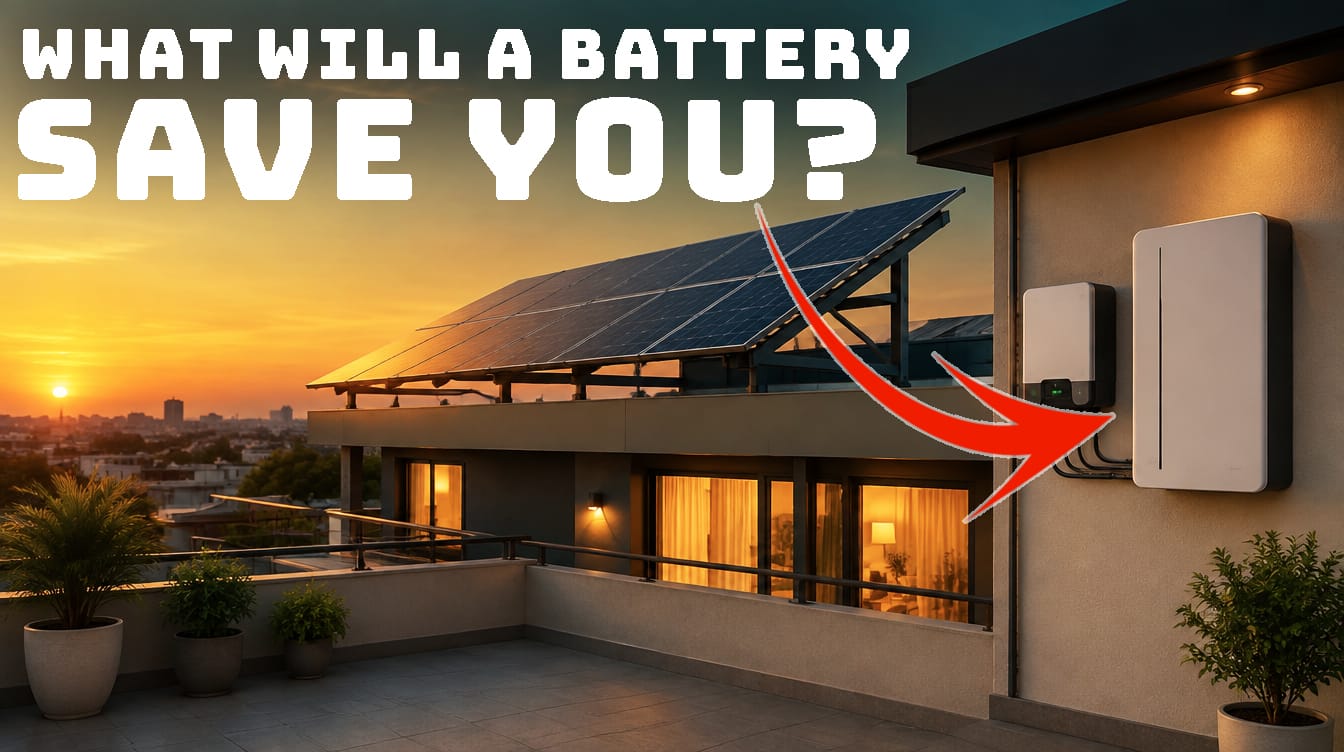
ToD tariff battery savings calculator for India
India’s grid batteries buy power at midday and sell it in the evening. Under Time of Day tariffs, your home, shop or factory can run the same trade. Enter your numbers and see what a battery actually saves you, including when it doesn’t pay back.
Fine-tune assumptions
Each stored solar unit gives up the first value and saves you the second.
estimated savings per year
Estimate only. Excludes fixed charges, taxes, surcharges, battery degradation and backup value during power cuts.
What is a Time of Day (ToD) tariff?
A Time of Day tariff charges a different price for electricity depending on when you use it. Power is cheapest during solar hours, when the grid is flooded with solar generation, and most expensive in the evening peak, when solar fades and everyone switches on lights, ACs and kitchens at once.
The Ministry of Power made ToD part of the Electricity (Rights of Consumers) Rules. The minimum rules every state regulator has to follow are simple:
| Consumer | Peak hours | Solar hours |
|---|---|---|
| Commercial and industrial (10 kW and above) | At least 1.2× the normal rate | At least 20% cheaper |
| All other consumers (except agriculture) | At least 1.1× the normal rate | At least 20% cheaper |
ToD applies only to the energy charge on your bill, not fixed charges. Solar hours run for eight hours a day, and the peak window can’t be longer than the solar window. A March 2026 draft amendment proposes firm deadlines of 1 April 2027 for commercial and industrial consumers and 1 April 2028 for everyone else, so check your state’s current tariff order for the exact slots and rates.
ToD tariff in Delhi
Delhi’s regulator, DERC, has applied ToD for years to non-domestic connections of 10 kW and above, with a 20% peak surcharge and a 20% off-peak rebate. It is optional for three-phase domestic connections. Delhi bills have also been climbing: in 2026 DERC let discoms recover a Power Purchase Adjustment Surcharge of up to about 18% in several months because buying power got expensive. The slots change from time to time, so confirm them on your latest BSES or Tata Power-DDL bill.
How a battery saves money under ToD
This is the same trade India’s grid-scale batteries make. They charge when midday power is cheap and sell during the evening peak, when prices can touch the ₹10 exchange ceiling. At home or in a factory the gap is smaller, but the logic is identical:
- Charge from your own solar: store the surplus your rooftop system makes at midday instead of exporting it for a low rate.
- Discharge at peak: run your evening load from the battery instead of paying the peak rate.
- Pay for losses: about 10% of the energy is lost in every charge and discharge, which the calculator accounts for.
This calculator assumes the battery charges only from rooftop solar, never from the grid. That is how we design hybrid systems, and it is the only case where the numbers are worth running.
Watch how India’s grid batteries earn up to ₹6 crore a day on this price gap, and why regulators want to control how they charge.
Three worked examples
Same formula as the calculator, 300 days a year, 90% efficiency. Battery prices are illustrative; use your own quote.
Home, net billing
₹8 normal rate, 10% peak surcharge, 5 units a day from rooftop solar that would export at ₹3, 5 kWh battery at ₹20,000/kWh.
≈ ₹8,200 / yearPayback around 12 years. On 1:1 net metering, it would barely save anything.
Shop, net billing
₹10 normal rate, 20% peak surcharge, 30 units a day charged from rooftop solar worth ₹3 on export, 30 kWh at ₹16,000/kWh.
≈ ₹78,000 / yearPayback around 6 years.
Factory, replacing diesel
₹8.50 normal rate, 20% peak surcharge, 100 kWh battery at ₹15,000/kWh charged from own solar worth ₹2 a unit. It covers 60 peak units and 40 units now run on a ₹28 diesel generator.
≈ ₹4.5 lakh / yearPayback around 3.3 years.
When a battery won’t pay back
We would rather tell you this upfront than sell you a battery that never earns its money back:
- 1:1 net metering. If every exported unit already earns you full credit, storing it in a battery adds little. The case strengthens when your state moves to net billing, where exports earn less than imports.
- Small homes. A 10% peak surcharge on a few evening units is a small gap to recover a battery’s cost.
- Low peak usage. A battery only saves on the units it actually moves. An oversized battery sitting half-empty just stretches the payback.
The strongest cases are commercial and industrial users with a 20% peak surcharge, their own rooftop solar and a diesel generator the battery can replace.
Before you buy a battery
- Check the warranty in cycles, not years. One cycle is one full charge and one full discharge.
- Depth of discharge should be at least 80%, or your usable capacity is much smaller than the label.
- The battery should work with other inverter brands, not only its own.
We explain why most batteries sold in India fail these checks in Why I Don’t Trust Any Solar Battery Sold In India.
Frequently asked questions
Is ToD tariff mandatory for homes in India?
The rules require ToD for commercial and industrial consumers of 10 kW and above, and for other consumers once smart meters are installed. A March 2026 draft sets deadlines of April 2027 for commercial and industrial users and April 2028 for others. Your state regulator decides the exact date and slots.
What are solar hours and peak hours?
Solar hours are an eight-hour daytime window, set by the state regulator, when electricity is at least 20% cheaper. Peak hours are usually in the evening and cost at least 10% more for homes and 20% more for commercial and industrial users.
Can a home battery pay for itself with ToD tariff alone?
Under 1:1 net metering, rarely, because exported solar already earns full credit. Under net billing, where exports earn much less than imports, the payback shortens, and backup during power cuts adds value that the calculator doesn’t count.
How big a battery do I need?
Size it to the units you actually use during peak hours. A battery larger than your evening load adds cost without adding savings.
Does Lumencity install batteries?
Yes. Lumencity designs hybrid solar systems with lithium battery storage for homes, businesses and factories. Send your calculator result on WhatsApp for a system sized to your bill.
Want a battery sized to your actual bill?
Share your last three electricity bills and we’ll work out whether storage makes sense for you, and how big it should be. If it doesn’t pay back, we’ll say so.
See hybrid solar and battery systemsSources: Ministry of Power, Electricity (Rights of Consumers) Amendment Rules 2023 and draft amendment of March 2026; DERC tariff schedules and FPPAS orders 2026; IEX and EAC-PM market data. Figures as of September 2026.